Generative AI platforms operate by processing vast datasets, and standard public tools often retain user inputs to train future models or improve performance. When an employee pastes unmasked data into an AI tool, that information leaves your organization’s perimeter and resides on third-party servers. Without strict sanitization, your organization faces severe regulatory fines under frameworks like GDPR, CCPA, or HIPAA for leaking PII, along with the irreversible loss of legal protection for trade secrets and proprietary code.
How to Implement the Checklist Daily
This checklist is designed as a quick-reference “pause button” for employees before submitting any prompt. Before hitting send, staff should treat every text field as a public broadcast. Sanitization does not mean compromising the quality of the AI’s output; large language models are exceptional at understanding abstract variables. By replacing explicit details with clear placeholders—such as [Client_Name] or [API_Key]—you allow the AI to perform complex analysis, formatting, or debugging without ever exposing actual sensitive assets.
Before clicking Send on any AI platform, run your content through this 5-step scrub protocol.
1. Scrub Personally Identifiable Information (PII)
Rule of Thumb: If it can identify a real person, strip it out.
- Names: Replace real names with generic roles (e.g., [Customer A], [User 1], [Employee X]).
- Contact Details: Remove all real email addresses, phone numbers, physical addresses, and social media handles.
- Government & Personal IDs: Strip out SSNs, passport numbers, driver’s license details, or taxpayer IDs.
- Sensitive Personal Data: Remove medical information (PHI), financial details, dates of birth, or biometric data.
2. Strip Proprietary & Intellectual Property (IP)
Rule of Thumb: If it’s a trade secret or competitive advantage, genericize it.
- Source Code: Strip out internal secrets, private API keys, connection strings, database passwords, and internal server URLs.
- Product & Brand Names: Replace unannounced project codenames, feature names, or client company names with placeholders (e.g., [Project Alpha], [Competitor Y]).
- Financials & Metrics: Mask specific revenue figures, margin targets, or non-public financial performance stats (e.g., change $4.2M Q3 revenue to [$X amount in revenue]).
- Strategy Documents: Remove proprietary workflow diagrams, patented algorithms, or internal strategic roadmap timelines.
3. Neutralize Security & Infrastructure Details
Rule of Thumb: Don’t give AI a map of your IT environment.
- Network Info: Remove internal IP addresses, subnet structures, or firewall setups.
- Credentials: Ensure zero plain-text passwords, tokens, or private keys are present.
- System Paths: Replace explicit file directories (e.g., C:\Users\Admin\SecretProject\…) with generic path structures (/path/to/file).
4. Apply the Sanitization Syntax
To keep the AI’s response clear and contextually accurate while staying safe, use explicit brackets or variables:
| Raw/Unsafe Input | Sanitized Safe Input |
| “Draft a reply to Jane Doe at acme@gmail.com about her $12,000 refund request.” | “Draft a reply to [Customer] at [Email] regarding their [Refund Amount] request.” |
| “Optimize this Python function connecting to DB host 192.168.1.50 with key sk_live_9921.” | “Optimize this Python function connecting to DB host [DB_HOST] with key [API_KEY].” |
5. The Final “Gut-Check” Decision Tree
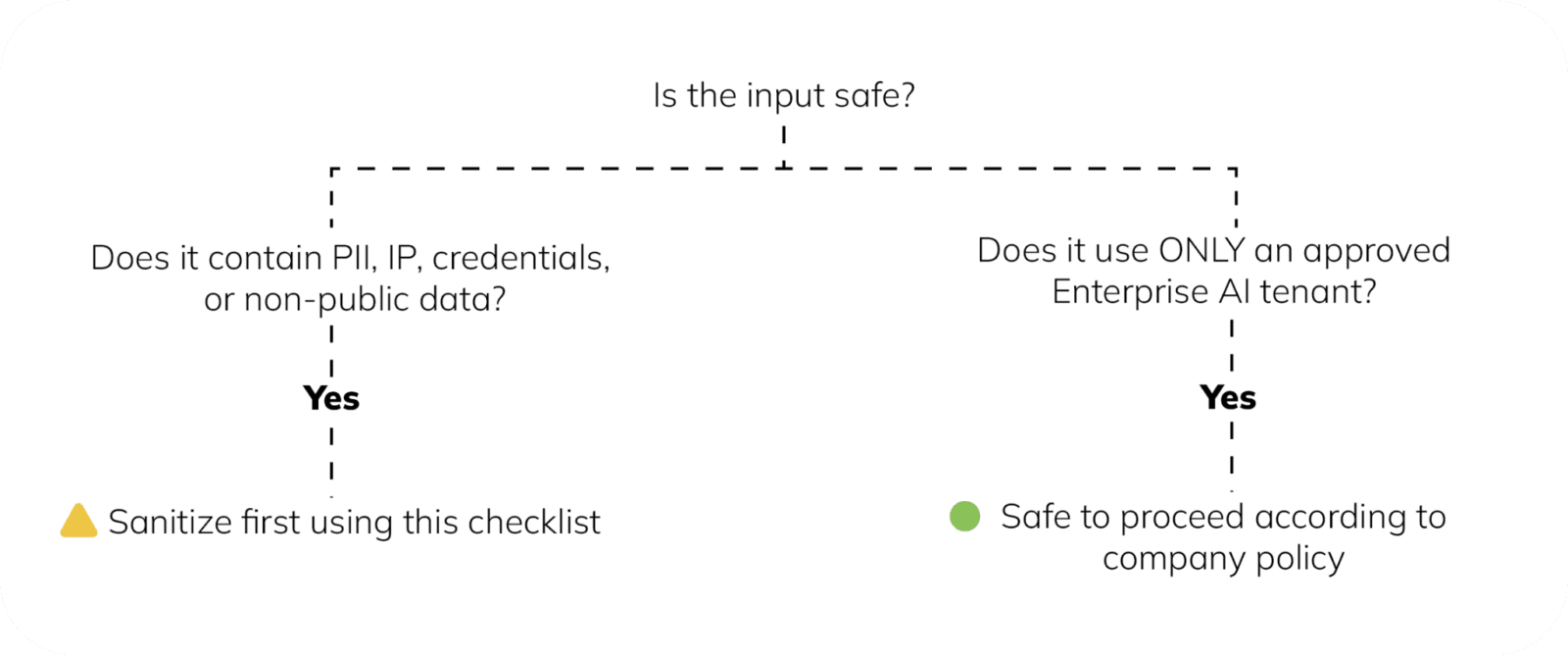
Policy Alignment & Safe Tools
It is important to note that sanitization is the primary defense line when using public, free, or third-party AI tools. If your organization utilizes a dedicated Enterprise AI agreement (where vendors explicitly contract to not retain data or train on inputs), the operational rules may vary. However, embedding a standard sanitization habit across all teams creates a defense-in-depth posture, ensuring that even if an unapproved tool is used, confidential company information remains completely secure.